
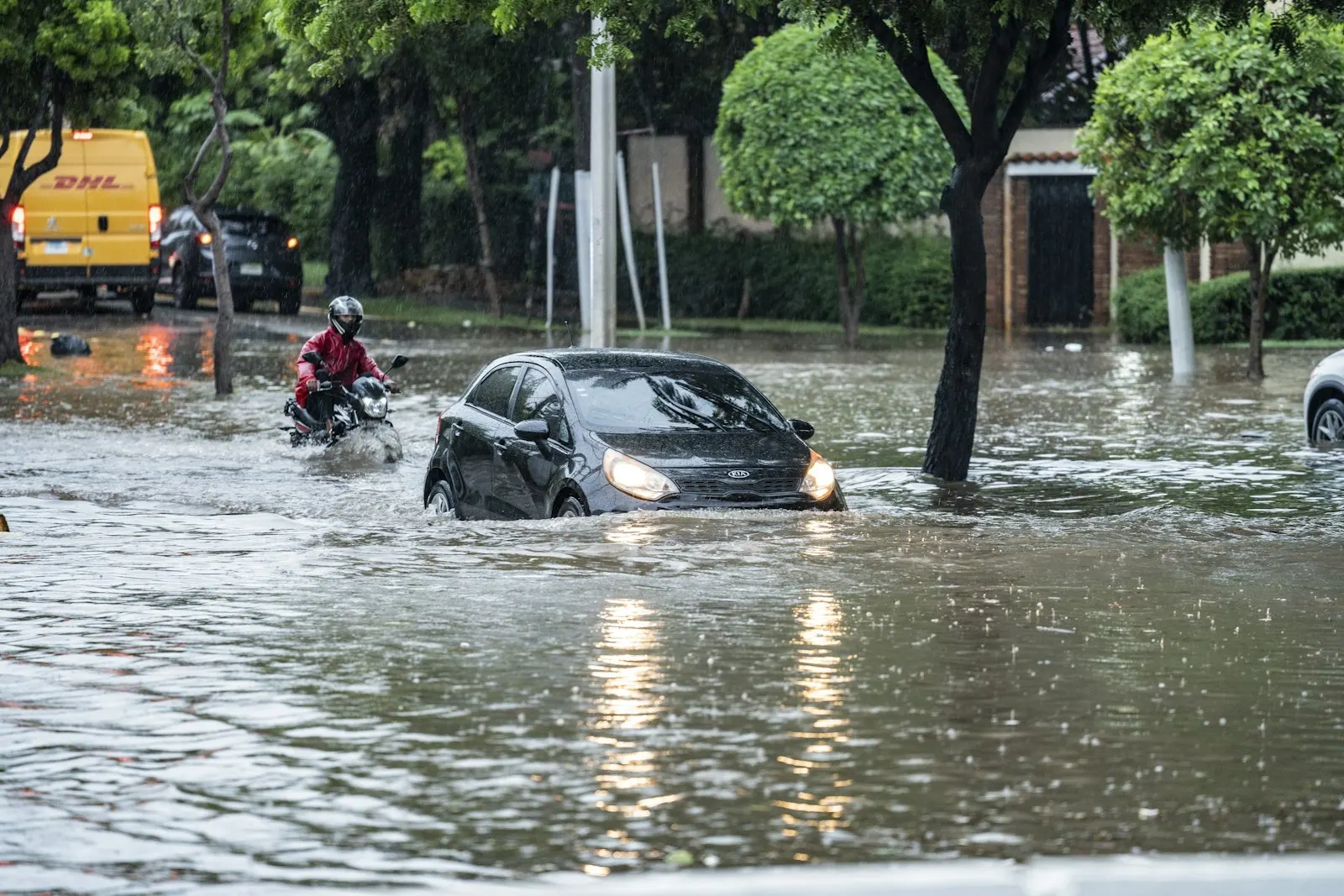
Why a little water is a big deal
In Miami, streets flood from afternoon storms, king tides, and clogged drains, not only from hurricanes. It happens fast, and the water almost always looks shallower than it is.
The National Weather Service puts it plainly. About six inches of water reaches the bottom of most passenger cars and can cause loss of control and stalling. A foot of water can float many vehicles. Two feet of moving water can carry away most vehicles, including SUVs and pickups.
You also cannot see what is under the surface. Open manholes, washed-out pavement, curbs, and debris all hide under brown water. The whole rule fits in four words: turn around, don't drown.
Know the streets that flood near you
Most street flooding is predictable. The same low intersections, underpasses, and parking lots fill up every time it pours. Learn the ones on your daily routes, to work, to school, to the store, and pick a backup route before you need one.
In the fall, king tides can push saltwater up through storm drains in low areas near the bay and the canals, sometimes on a sunny day. That water is salty, which makes it far worse for your car than rainwater, even when it is only a few inches deep.
After a heavy downpour, give the drains time to catch up. Waiting it out in a parking lot or a gas station is boring, but it beats a tow, a soaked interior, and a repair bill.
What water does to your car
Your engine breathes through an air intake that often sits low in the front of the car. If it pulls in water, the engine can hydrolock. Water does not compress, so the pistons stop hard and parts bend or break. That can mean a new engine.
Water also gets into places built to stay dry: the vents on the transmission and differential, the wheel bearings, the electrical connectors, and the computer modules that run the car. Water in transmission fluid turns it milky and wears parts fast. Wet connectors corrode and set off warning lights weeks later.
Brakes get wet and lose grip until they dry. Carpet and padding soak up water and can grow mold if they are not dried out. Saltwater from tidal flooding is the worst of all, because it keeps eating metal and wiring long after it dries.
If you have to go, drive it like this
Sometimes there is truly no other road. Only go if the water is not moving, it is below the middle of your wheels, and you can see the far side. Stay in the center of the road, which is usually the highest point.
Drive at a slow, steady walking pace so you do not push a wave up over the hood. Do not follow a truck or bus closely, because its wake can push water into your air intake. Do not stop in the middle, and do not shift gears once you are in it.
When you come out, tap the brakes lightly a few times at low speed to dry them before you actually need them.
Two hard rules. Never drive into water at night, when you cannot judge how deep it is. And never drive around a barricade. Streets get closed for a reason, and the water past the barricade is often deeper or faster than it looks from the edge.
If the car stalls in the water
Do not try to restart it. If water got into the engine, cranking it can cause the damage that has not happened yet.
Turn on your hazard lights. If the water is rising or moving, get out and get to higher ground. A car can be replaced and you cannot. If the doors will not open against the water, lower the window and climb out.
Once you are safe, call for a tow. Ask for a flatbed, especially for an all-wheel drive car, a hybrid, or an EV, and tell the driver the car stalled in water so nobody tries to jump start it on the spot.
Keep a small window breaker and seatbelt cutter tool where the driver can reach it without unbuckling, like the center console or the door pocket. You hope never to use it. In a car that is filling with water, it can be what gets you out.
After you drive through water: what to check
Pull the engine oil dipstick. Milky, light brown, or foamy oil means water got inside. Do not drive it. Check the engine air filter too. A wet filter, or one with a dirty water line on it, means water reached the intake.
Look at the carpet and under the floor mats, and pay attention to any musty smell over the next few days. Watch for new warning lights, a rough idle, a transmission that shifts strangely, or a humming or grinding noise from one wheel.
If anything feels off, or if the water reached the bottom of the doors, have the car inspected. Changing contaminated fluids and drying connectors early costs far less than chasing corrosion and electrical problems months later.
Hybrids, EVs, and insurance
Hybrids and EVs are sealed against rain and normal puddles, but deep water is a different story, and saltwater most of all. If an EV or hybrid sat in floodwater, do not charge it or drive it until it has been inspected. In the meantime, keep it parked outside and away from buildings and other cars.
Flood damage is usually handled under comprehensive coverage, if you carry it. Take photos of the water line and the interior before anything gets cleaned or thrown out, and call your insurer before you approve major repairs.
We inspect flood-exposed cars, trucks, hybrids, and EVs, write down what we find in plain language, and can work with your adjuster from there. If you are not sure whether the water got in, that alone is a good reason to have it checked.